Remote Assets

IoT Data Logger – Remote Monitoring System

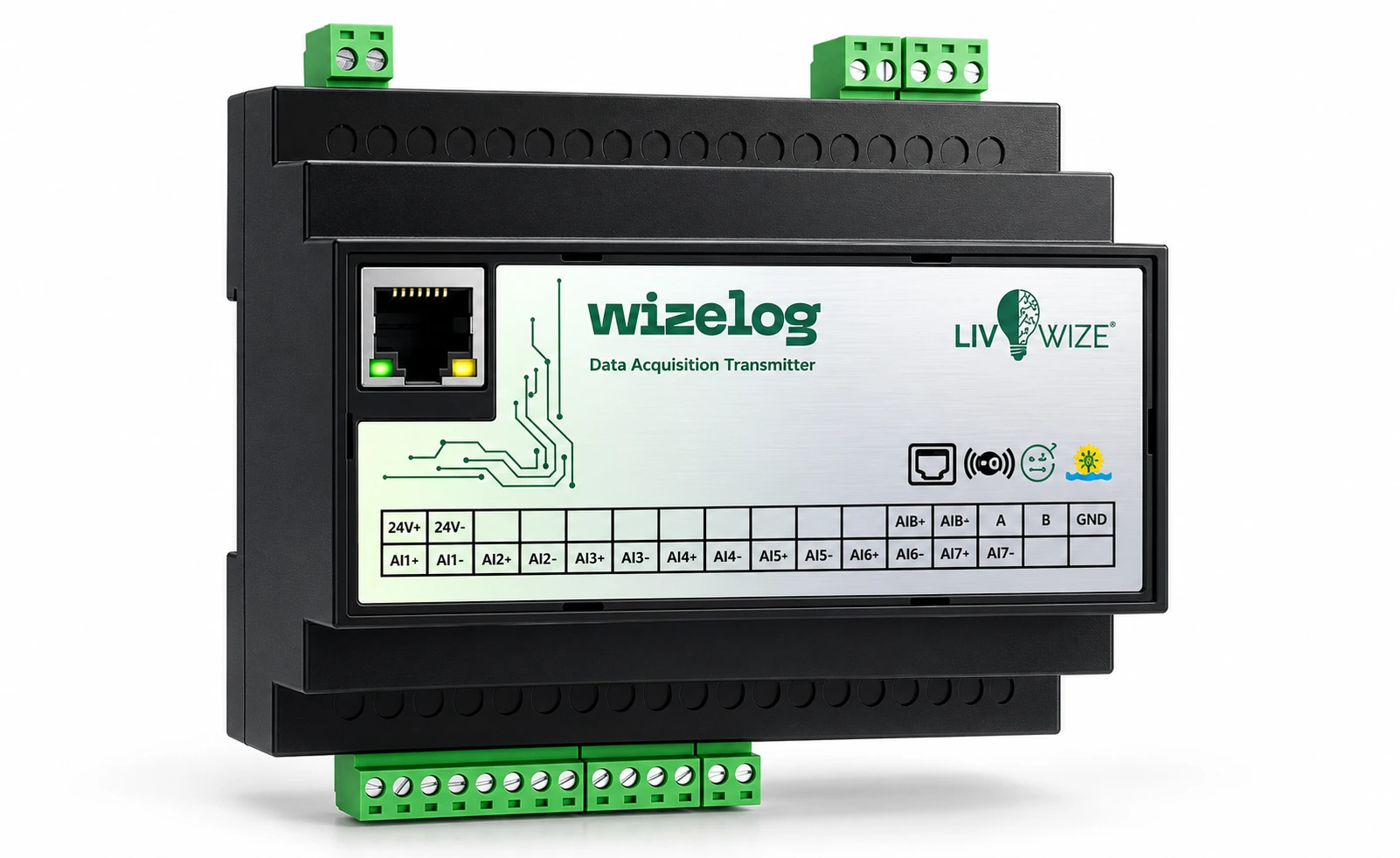
An IoT data logger collects analogue, digital and Modbus readings, stores them locally and sends them to a remote dashboard. Livwize’s remote-monitoring logger combines 4G LTE, Wi-Fi or Ethernet connectivity with SD-card storage for industrial equipment and connected field sensors.

Connect compatible field instruments through 4–20 mA analogue channels, digital inputs and outputs or RS485 Modbus RTU. Ethernet, Wi-Fi and 4G LTE carry readings to the monitoring platform, while onboard SD storage keeps a local measurement history.

  • Analog Inputs:

    4/8 × 4–20 mA

  • Storage:

    SD Card (local cache, up to 16 GB)

  • Networking:

    4G LTE / Wi-Fi / Ethernet (failover)

Livwize IoT data logger for remote monitoring

Overview

Data Logging from Field Instruments to Remote Dashboards

Collect measurements from sensors, meters and equipment in one connected workflow. The logger time-stamps readings, stores them locally and uploads records to a remote platform so operators can review current conditions and historical trends without a site visit.

Why Choose This IoT Data Logger?

Timestamped data handling: Keep each reading associated with its channel and recording time. • Multiple connectivity paths: Configure 4G, Wi-Fi or Ethernet for the available site network. • Local and cloud storage: Retain readings on the SD card and upload stored records when connectivity returns. • Historical records: Use logged measurements to investigate equipment conditions and network interruptions.

Timestamped data handling

Local and cloud storage

Technical Specifications

Serial: RS485 (Modbus RTU)

Protocols: MQTT, HTTP(S), Modbus RTU/TCP, FTP, SNTP

Power: 9–30 V DC | Temp Range: -20°C to +70°C Mounting: DIN-rail or wall mount

Capabilities

Key Features

Combine instrument integration, local recording and remote access to build a useful measurement history. Configure the channels, upload intervals and alerts for the equipment and operating conditions at each site.

  • 4/8 × 4–20 mA isolated analogue inputs for compatible industrial sensors

  • 1 × RS485 (Modbus RTU) for meters, analysers and field instruments

  • 4G LTE, Wi-Fi (2.4 GHz) and Gigabit Ethernet with configurable failover

  • Built-in SD card (local buffer) with CSV and time-series export

  • Support for MQTT, HTTP(S), Modbus RTU/TCP, FTP and SNTP

  • OTA firmware updates, remote configuration and diagnostic tools

  • Timestamped data uploads at configurable intervals

  • Support secure, auditable logs and backups in case of interruptions.

Use Cases

Data Logging and Remote-Monitoring Applications

Equipment and energy monitoring: record compatible meter and machine readings. • Water and utilities: track level, flow and pressure inputs. • Temperature and storage: keep a history of connected sensor measurements. • Environmental monitoring: connect suitable emission or effluent analysers for a CPCB/OCEMS reporting application, with the configuration agreed for the site.

Target Markets

Industrial Deployment Examples

Record measurements across industrial facilities, utility systems and remote sites, with the instrument interfaces and connectivity selected for each installation.

Manufacturing facilities Energy and equipment monitoring Water and utility systems Remote sites and installations Industrial instruments Storage and process monitoring

CEMS and 4–20 mA data logger: specifications

These specifications describe the remote-monitoring logger. Check the channel configuration and supplied model when planning the installation.

Use the IoT sensors guide to compare measurement types and interfaces for the installation.

Published remote-monitoring logger specifications
Specification Value
Analogue inputs 4 / 8 × 4–20 mA
Serial interface 1 × RS485, Modbus RTU
Network 4G LTE / Wi-Fi 2.4 GHz / Ethernet
Protocols MQTT, HTTP(S), Modbus RTU/TCP, FTP and SNTP
Local storage SD card, up to 16 GB
Power 9–30 V DC
Operating temperature −20°C to +70°C
Mounting DIN rail or wall mount

Frequently asked questions

What happens when the logger loses its network connection?

Local storage retains readings so the deployment can continue recording during a communications interruption. Review buffering and resynchronisation requirements for the selected configuration.

Can the logger connect analogue and Modbus instruments?

The published interfaces include 4–20 mA analogue channels and an RS485 Modbus RTU interface. Confirm channel count and instrument compatibility when selecting the model.

Which networks can the logger use?

The logger supports 4G LTE, Wi-Fi and Ethernet. Choose connectivity for the available site network and confirm failover settings for the supplied configuration.

How often can the logger record and upload data?

Logging and upload intervals are configurable for the supplied firmware. Select the interval for the measurement, network conditions and storage available at the site.

Can the logger send data to our own server?

The published interfaces support MQTT, HTTP(S), Modbus RTU/TCP and FTP workflows. Confirm the endpoint, authentication and payload format with Livwize when planning a third-party server integration.

Ready to Deploy

Deploy Remote Monitoring Today

Get real-time visibility into your remote assets from anywhere in the world.